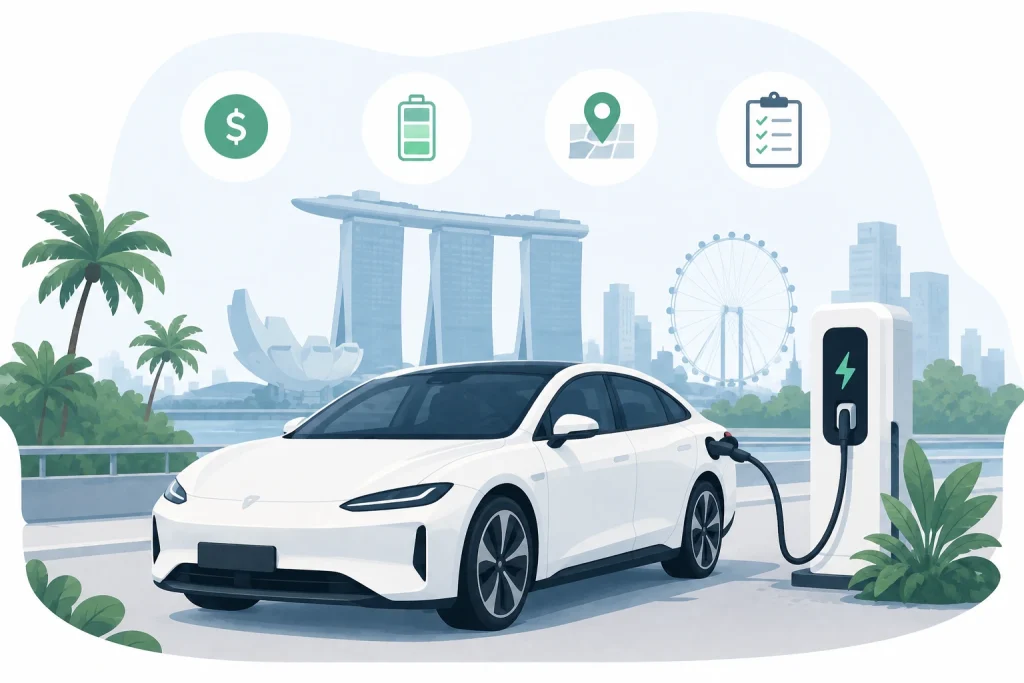
Choosing an electric car in Singapore now involves more than comparing purchase prices and battery figures. From January to August 2025, about half of newly registered cars and taxis were electric models, according to the Land Transport Authority (LTA) and National Environment Agency (NEA), showing how quickly EVs have entered mainstream consideration.
Buyers still need to account for Certificate of Entitlement (COE) premiums, registration incentives, road tax, EV charging in Singapore, real-world range, and access to home or public chargers. These factors determine whether an EV fits a household’s budget and routine.
For buyers comparing body styles, Volkswagen Singapore’s electric range includes SUVs, higher-performance variants, a passenger van, and a cargo model, providing practical options to assess against their space, driving, and charging needs.
Quick Summary
- An electric car Singapore dealerships offer runs entirely on battery power and produces no tailpipe emissions while driving.
- Purchase decisions should account for COE, registration taxes, rebates, road tax, insurance, and charging costs.
- Under the 2025 joint policy update from LTA and NEA, eligible electric cars registered in 2026 can receive a 45% Additional Registration Fee (ARF) rebate capped at S$7,500.
- Convenient EV charging in Singapore often matters more than maximum charging speed.
- Actual driving range varies with speed, traffic, passenger load, climate control, and battery level.
What Is an Electric Car?
An electric car is powered by one or more electric motors using energy stored in a rechargeable battery. Unlike petrol or diesel vehicles, it does not rely on an internal combustion engine. The LTA’s Electric Vehicle Guide for Drivers also states that EVs produce no tailpipe emissions while operating.
Key characteristics of an EV:
- Powered by a high-voltage traction battery
- Recharged through an external electricity supply
- Uses an electric motor rather than a petrol or diesel engine
A fully electric car is different from a conventional hybrid or plug-in hybrid, both of which retain a combustion engine. Buyers researching electric vehicles in Singapore can review electric-car technology and ownership information to understand battery design, charging, and everyday use.
Why Electric Cars Matter in Singapore: Costs and Ownership Context
Upfront Purchase Costs
The price of an electric car in Singapore reflects more than the vehicle itself. Registration expenses can include COE, the Additional Registration Fee, and emissions-based adjustments. For eligible electric cars registered in 2026, the current LTA incentive framework provides a 45% ARF rebate capped at S$7,500 under the EV Early Adoption Incentive. The revised Vehicular Emissions Scheme (VES) Band A rebate is S$22,500, bringing potential combined savings to as much as S$30,000, subject to eligibility.
Ongoing Ownership Costs
Running expenses vary according to annual mileage, charging location, electricity tariffs, insurance, road tax, tyres, servicing, and ownership duration. A meaningful comparison should therefore combine acquisition and ongoing costs. Battery coverage also deserves attention. Volkswagen states that its battery-electric vehicles carry an eight-year or 160,000 km high-voltage battery warranty, whichever comes first, under its stated electric-vehicle warranty terms. Buyers should check current exclusions, maintenance requirements, and model-specific conditions before purchase.
How Electric-Car Charging and Range Work
Where and How the Car Is Charged
Electric-car charging begins with the connection available at home, work, or a public carpark. AC and DC chargers serve different needs, so the fastest option is not always the most practical for routine use.
| Charging type | Common use | LTA illustrative estimate | Key consideration |
| AC | Overnight and routine charging | Around 4 hours from 20% to 80% | Usually slower and widely available |
| DC | Urgent or opportunistic top-ups | Around 1 hour from 20% to 80% | Charging may slow near 80% |
As per LTA’s EV driver guide, Singapore’s public chargers use Type 2 connections for AC charging and Combo 2 for DC charging. Actual times depend on the charger, vehicle, battery temperature, and state of charge.
What Determines Charging Time
Charging time depends on several linked factors:
- Charger power
- The vehicle’s onboard charging limit
- Battery capacity and state of charge
- Battery and ambient temperature
- The vehicle’s charging curve
Charging is generally quickest between 20% and 80%. Volkswagen explains in its Singapore EV charging overview that the rate may fall beyond 80% to control voltage and support battery longevity.
Understanding Usable Driving Range
Official range figures offer a standardised basis for comparison, not a guaranteed result for every journey. Actual electric-car range varies with speed, traffic, passenger and luggage load, air-conditioning use, road conditions, and battery temperature. Buyers should compare the stated range with their regular weekly mileage and preferred EV charging in Singapore routine.
Electric-Car Ownership Suitability in Singapore
Suitability depends on parking access, weekly mileage, and passenger or cargo needs.
Housing and Development Board (HDB) Resident Using Public Charging
- Scenario: The driver has no reserved home charger.
- What to consider: The LTA’s EV roadmap reports that “all HDB towns are EV-ready”, while the Ministry of Transport states that more than 90% of HDB carparks had been equipped with charging points by December 2025. Drivers should still check charger availability, connector type, operator fees, and idle-charge rules at the locations they expect to use.
- Practical implication: Public EV charging in Singapore works best when it fits normal parking routines.
Condominium or Landed-Home Resident
- Scenario: The household may install or share a charger.
- What to consider: Condominium residents need approval from the property owner or management corporation. The EV Common Charger Grant supports eligible shared installations until 31 December 2026, or until 3,500 chargers receive co-funding.
- Practical implication: Overnight AC charging can reduce reliance on public fast chargers.
Family or Business Buyer
- Scenario: Seating, luggage, accessibility, or cargo space is a priority.
- What to consider: Compare space, range, charging capability, warranty support, and typical journeys.
- Practical implication: Volkswagen’s range of electric vehicles in Singapore lets buyers compare passenger and commercial formats against practical needs.
Common Electric-Car Misconceptions
Myth #1: Charging Habits
Myth: The battery must reach 100% before every trip.
Reality: Partial charging is often enough. The LTA driver guide notes that charging is usually fastest between 20% and 80%.
Myth #2: Charger Speeds
Myth: All public chargers are equally fast.
Reality: Speed depends on charger output, vehicle limits, and battery condition.
Myth #3: Range Expectations
Myth: Official range is fixed.
Reality: Traffic, speed, payload, and air-conditioning affect usable range.
Myth #4: Maintenance Needs
Myth: Electric cars need no servicing.
Reality: Volkswagen’s EV ownership guidance lists tyres, brakes, suspension, diagnostics, and battery systems as ongoing checks.
Myth #5: Driver Suitability
Myth: Every driver benefits equally.
Reality: The suitability of electric cars in Singapore depends on charging access, mileage, space, and budget.
Frequently Asked Questions
How much does an electric car cost in Singapore?
Prices vary by model and COE. Compare the vehicle price, ARF, road tax, insurance, financing, and charging costs.
What rebates are available for electric cars in 2026?
Under the 2026 EV incentive framework, eligible fully electric cars receive a 45% ARF rebate capped at S$7,500. Combined EV Early Adoption Incentive (EEAI) and VES savings can reach S$30,000.
Can HDB residents own an electric car without a private charger?
Yes, provided accessible public EV charging fits their routine. LTA provides live charger availability through the MyTransport.SG application.
How long does an electric car take to charge?
The official EV driver guide gives illustrative 20% to 80% estimates of around four hours with AC and one hour with DC, although actual times vary.
How far can an electric car travel on one charge?
Electric-car range depends on the model, speed, load, climate control, road conditions, and battery state.
Do electric cars cost less to maintain than petrol cars?
EVs generally have fewer moving parts and fluids, but tyres, brakes, suspension, battery systems, and diagnostics still need attention, as reflected in Volkswagen’s current service information.
Choose an Electric Car That Fits Your Routine
Choosing an electric car in Singapore means weighing total ownership costs, charging access, practical range, space, and regular driving needs. Check current incentives, tariffs, warranty terms, and model specifications before making a decision.
To compare passenger and commercial options, explore Volkswagen’s electric vehicle range in Singapore.